
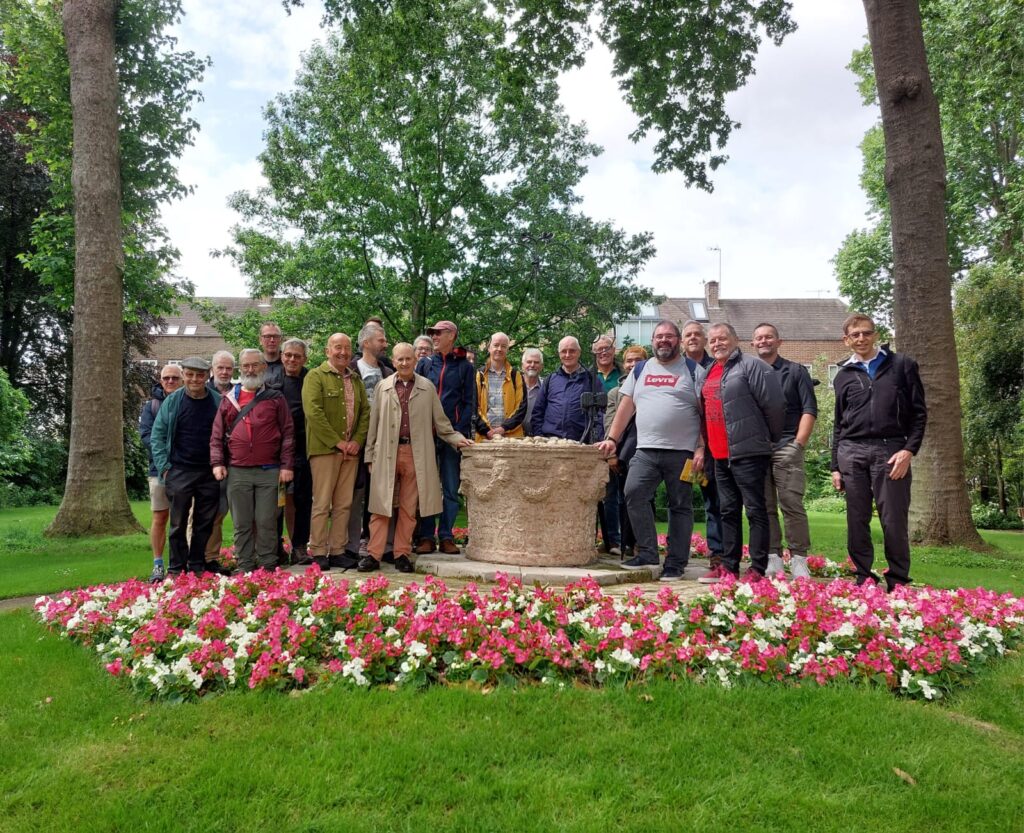
Michael Daniels organized this interesting GOC London and Gardens Group event, rather different from our usual offer, which took a rare opportunity to visit the private and secluded residential gardens of the Hyde Park Estate. This affluent neighbourhood is situated in the triangle of land between Bayswater Road, Edgware Road and Sussex Gardens in Paddington. Despite the name and central location, this is a relatively unknown area of London. The gardens only open to the general public one day a year, so this was an opportunity not to be missed.
Because of the weather forecast it looked slightly touch and go whether the event would go ahead, but in the end a decision was made that we shouldn't miss the opportunity, and in any case weather forecasts are quite often pessimistic!
24 GOC members assembled in plenty of time at Lancaster Gate tube station. Michael led us off shortly after 10.30. Michael gave us a briefing once we were away from the busy and noisy main road. The estate, originally called Tyburnia, had been in the hands of the Bishops of London and latterly The Church Commissioners for centuries. They had redeveloped the estate extensively after the war, so much of the housing was post-war 1960s rather than the Georgian terraces that might have been expected in that area.
The first garden we visited was Gloucester Square, a traditional garden square, long and narrow and with some flats having direct access to the garden without having to cross a street. There were some musicians in the garden playing soft jazz, which was a nice feature.
The next garden, Coniston Court, was my favourite. It was designed with curved gravel paths, a range of planting styles, varied planting, and hidden corners, as well as a small greenhouse which I think was a “buckyball” design. We then walked to a small raised planted area called Reflections 2020, about which there was not much to say except that any planting is welcome in an urban area.
Next up was The Quadrangle, which was a large inner courtyard of residential blocks, subdivided into a variety of different planting zones, including herbaceous borders, annual and perennial displays and two raised wildflower meadows.
Our fifth stop was The Water Gardens, which had been completely refurbished in 2018. It was quite similar to the Barbican with its lake, although on a smaller scale, and a variety of different areas. There were horizontal fountains, a variety of regular ponds with aquatic vegetation and fish, overlooked by suspended decking. This garden was the designated lunch stop, for which there was plenty of available seating.
Our penultimate visit was the Devonport garden, presumably named after the naval dockyard, and equipped with two old George the Third cannons. It was another attractive garden with tall trees, dense shrubs, winding paths and different themes, all having the effect of making it seem bigger than it was. The last garden, Oxford Square, was a little like the first, Gloucester Square, though smaller and more open. The jazz musicians from earlier had moved venues and were now playing here - which provided a nice bookend to the day. There was also a tent serving hot drinks, and two women dressed in - and entirely covered by - flowers, including over their faces.
It had been a most enjoyable as well as informative visit of a little-known area. The imaginative planting and garden design set off the mostly quite utilitarian 60s buildings in a very attractive way. An interesting part of London, different from any other I've visited. Everyone seemed to enjoy the day; the rain that we had expected didn't happen except for a few spots.
I would like to thank Michael very much for such an informative and fascinating event. It goes to show what outdoor options there can be in our capital city, which we sometimes overlook.
Afterwards Martin Gilbraith had organised a GOC social at The King's Arms in Poland Street. Some people decided to walk, while others caught the 98 bus. That is reported elsewhere!
Andy Fisher


