


Event led by Mark G
Attendance: 12 including 2 new joiners
Distance: 13.71 miles (22.6 km)
Time: start 11:21 am, lunch 41 minutes, finish 5:21 pm
Terrain: woodland, footpaths, bridleways, farm tracks and road.
Elevation: total ascent 1110 ft, highest 228ft and lowest 105m
Weather: Sunny 20 -22 C with light Southerly winds
Number of sewage work: 0
Number of churches: 2
Number of golf courses: 1.5
Number of pick-your-own farms: 1
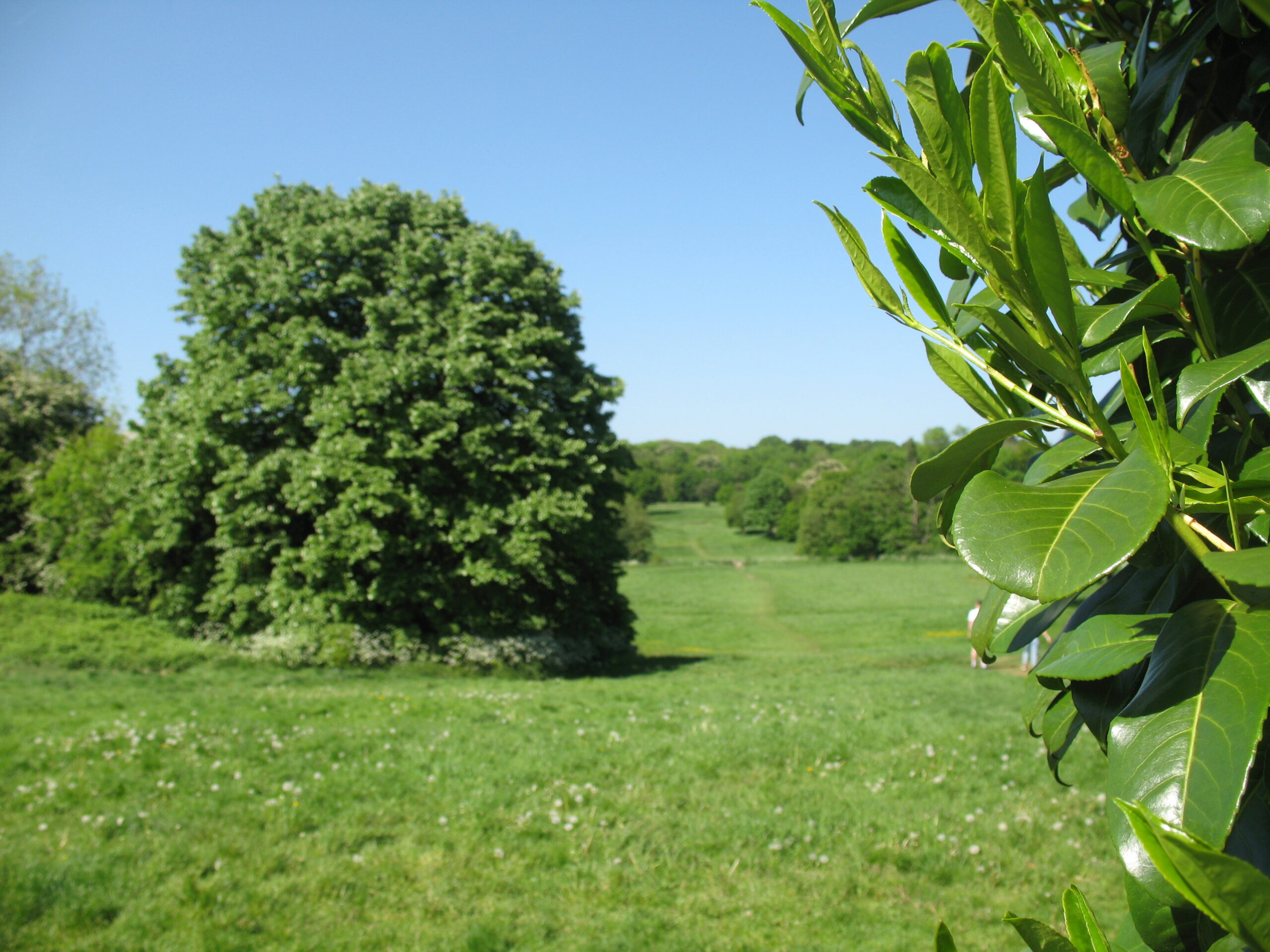
This was an almost circular walk from Oakwood to Cockfosters via Trent Park, Hilly Fields, Whitewebbs and Forty Hall in the London Borough of Enfield.
Our walk started at Oakwood tube station. After a short walk from the station, we entered Trent Park at its most south easterly point, leaving after a few minutes to join the Merryhills Way, a footpath running east which borders the open fields between Oakwood and the main part of Western Enfield and home to three shire horses which were happy to pose for selfies with some of our number. Following the path through woodland, we walked along The Ridgeway and past Chase Farm Hospital before turning down a bridleway which took us across open farmland. We walked across the Stevenage to Moorgate train line using one of the few open railway foot crossings in Greater London. Following this path towards Clay Hill, we stopped briefly to admire a small herd of goats before reaching Hillyfields, our second park of the day. From Hillyfields, we crossed over Clay Hill itself and into the bottom of Whitewebbs Park (full history below) and followed the wooded pathway into the adjacent Forty Hall Estate, entering past the estate farm and into the beautifully kept walled garden which was our lunch stop. A full history of Forty Hall, very much one of the jewels of the Borough, follows below.
Having recharged ourselves, we walked across the open parkland, taking a circular route back into Whitewebbs, where the cafe proved popular for drinks and ice creams. Following the path in a westerly direction, we crossed over the Flash Lane Aqueduct, once part of the original New River water supply system before retracing our steps back to the Ridgeway and along the Hadley Road, past the Parkside Farm self-pick fruit and veg centre and back into Trent Park (full history below) at the top right corner. This was the last phase of the walk, taking us along the northern edge of the park, down past the new housing development that now occupies the former Middlesex University site, past the Go-Ape treetop adventure centre and out to Cockfosters station, our end point. A few members then retired to The Cock Inn, a few streets away.
We visited the following:
Trent Park which dates to the fourteenth century when it was a part of the Enfield Chase, one of Henry IV’s hunting grounds. In 1777, George III leased the site to Sir Richard Jebb, his favourite doctor, as a reward for saving the life of the King's younger brother. The duke chose the name Trent, because it was in Trent, Italy, that the King's brother had been saved. Upon his death the house was sold to Lord Cholmondeley. In about 1836 the house was bought by the banker David Bevan for his son on his marriage to Lady Agneta Yorke. In 1909 the estate was sold to Sir Edward Sassoon, father of Philip Sassoon who inherited the estate in 1912 upon his father's passing. He went on to entertain many notable guests at Trent Park, including Charlie Chaplin and Winston Churchill. Sir Philip Sassoon died in 1939 and the house was requisitioned by the government for use during the Second World War. Trent Park was used as a centre to extract information from captured German officers. During the Battle of Britain in 1940, captured Luftwaffe pilots were held initially at Trent Park. The rooms at Trent Park had been equipped with hidden microphones that allowed the British to listen in to the pilots' conversations. This provided information about the German pilots' views on several matters, including the relative strengths and weaknesses of German aircraft.
Later in the war it was used as a special prisoner-of-war camp dubbed “The Cockfosters Cage.' for captured German generals and staff officers. They were treated hospitably, provided with special rations of whisky and allowed regular walks on the grounds. The hidden microphones and listening devices allowed the British military to gather important information and an intimate insight into the minds of the German military elite.
In 1973 Trent Park was opened to the public as a country park, which at that time surrounded the university buildings and is 320 hectares in area.
For some years, country park included publicly accessible countryside, farmland, a golf course and an equestrian centre. Some of the grounds were attractively landscaped by Humphry Repton in the English manner and some also attribute the work of Capability Brown. Features of the original landscaping that can still be seen include an impressive avenue of lime trees, an obelisk and an ornamental lake. The Obelisk was brought from Wrest Park, Bedfordshire in 1934 to impress the Duke and Duchess of Kent.
In late 2017, a decision was made to redevelop the area include 200 homes. Some of the heritage buildings were to be re-purposed into luxury apartments; the plan included a museum on the two lower floors of the mansion, expected to open in 2020. The Middlesex University buildings were removed.
Forty Hall is a manor house of the 1620 - 30s. The house is a Grade I listed building. The house was built between 1629 and 1632. It is generally said to have been built by Sir Nicholas Rainton, a wealthy London haberdasher who was Lord Mayor of London from 1632 to 1633. However, a writing in 1858, says that it was built by Sir Hugh Fortee and bought by Raynton.
The detailed history of the house has until recently been poorly understood, since it is known to have been built in the late 1620s, has the external appearance of an 18th-century house. A detailed examination was carried out for Enfield council as part of the Forty Hall Conservation Plan. This concluded that the house was probably not designed by a famous architect such as Inigo Jones, but by a "clever artisan builder".
The original square house was not altered much in the 17th century other than a small extension to the north-west in 1636. In 1640 Rainton was imprisoned for refusing to help Charles I raise a loan. He died in 1646 aged 77. The hall then passed to his great-nephew, also Nicholas. He was able to extend the estate northwards by buying and demolishing the neighbouring Elsyng Palace in 1656. In 1696 the hall passed to John Wolstenholme (probably a descendant of the financier and merchant of the same name. who carried out major refurbishment possibly following a fire, including construction of an extension to the south-west, and planted the avenue. In 1740 the house passed to Eliab Breton, who remodelled the ground floor. Later owners included Edmund Armstrong (1787) and James Meyer (1799), whose family built the nearby Jesus Church in 1835. In 1894 the hall was bought by Henry Bowles of the neighbouring Myddelton House for his son Major Henry Bowles (1858–1943), MP for Enfield and later 1st Baronet Bowles. In 1897 there were further changes including enlargement of the south-west wing. In 1951 the Bowles family sold it to the Borough of Enfield. It has since been used as a museum. The Hall closed to the public in late 2010 for a major redevelopment project funded by Enfield Council and the Heritage Lottery Fund. The Hall reopened on 30 June 2012.
Whitewebbs Park is located in London’s Green Belt. In 1931 an enlightened combination of Middlesex County Council and Enfield Urban District Council bought the private estate as open space for the people of Enfield. The original 999 year lease protected this open space while allowing part of the land to be used for recreational sport.
The park covers about 240 acres with a large area of ancient woodland – mostly Oak and Hornbeam with Holly and many other tree species. The parkland associated with Whitewebbs House was used for the golf course. The more formal parkland in the North has a lake and the remains of formal Victorian gardens.
The park is rich in biodiversity with many species of trees, mixed grassland, wild flowers and 80 species of birds. Predators such as buzzards and hawks as well as ducks, geese, herons, egrets, cormorants, kingfishers, woodpeckers, nuthatches and many, many other smaller birds.
Report by M Graver and photos Khris



14 May 2022 Enfield Countryside - Trent Park and Forty Hall
