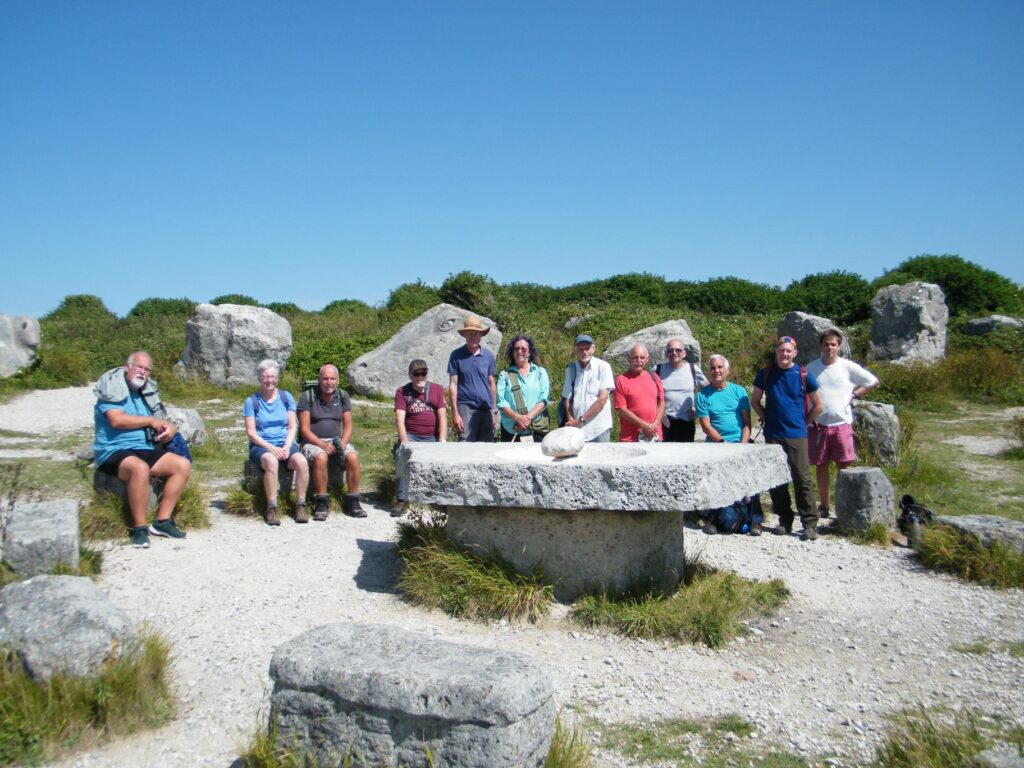


This was a circular walk of 4.5 miles, from Welwyn, E towards Harmers Green, S towards Welwyn Garden City, then NW to Welwyn. After the walk was lunch in a pub.
The usual stats:
-
Event led by Martin T.
-
Attendance: 10 men.
-
Distance: 4.51 miles (7.3 km).
-
Altitude per GPS: low 331ft (100.9m), high 557ft (169.8m), climb 892ft (271.9m), descent 866ft (264m).
-
Time: start 11:23, end 13:02 (sunset 16:12).
-
Speed: moving arithmetic average 2.82mph (4.5kph).
-
Weather: overcast, temperature up to 3°C, northerly wind ~7mph (11.3kph).
-
Number of sewage works: 0.
-
Number of churches: 1.
-
Number of golf courses: 0.
Points of interest:
-
Welwyn village has tonnes of history. It likely formed around Belgae Celtic settlements on relatively stable ground in a generally marshy area near the river (now the River Mimram), making it an ideal fording point. The Romans subsequently took advantage of this, the old Roman road likely being that between Verulamium (St Albans) and Ermine Street at Braughing (source). There is little evidence of a Verulamium-sized Roman development at Welwyn, but there is evidence of plenty of villas. With the villas came the Roman baths, the ruins of which are now a museum (with limited opening hours).
-
As with other Roman settlements, urban development slowly accumulated around the Romans’ infrastructure entrails. The fording point eventually became the Great North Road. The ford, in combination with Welwyn’s very narrow roadway, resulted in heavy congestion, giving Welwyn the perfect excuse to became a coaching stop up to the late 1700s, until the railway by-passed Welwyn in 1850, at which point the whole commercial case of coaching inns evaporated overnight. The peace didn’t last: upon the advent of the motor vehicle, Welwyn’s ultra-narrow Great North Road facilitated yet more congestion, resulting in a by-pass in 1927 (said to be the first by-pass in Britain). The by-pass is first visible in the OS maps of 1947; the alignment is still in use today as the Welwyn Bypass (fragment on a map; now part of the A1000). In the 1960s, a new road, the A1M was built, joining with the northern point of the then existing Welwyn by-pass (now A1000). The southern alignment of the A1M was built in 1973, thus completely by-passing the by-pass!
-
actually, there might have been an ever earlier by-pass, of sorts. The Great North Road ran through Welwyn through a ford of the River Mimram. At some time, perhaps after 1804-1815 (or after the revised maps of 1831-1832) and before 1865-1880, somebody built a bridge over the river. This by-passed the river, at least, but probably did little to relieve congestion on the Great North Road.
-
the legacy of by-passes by-passing by-passes has resulted in an awful lot of concrete, brutally carving its way between Welwyn village and Welwyn Garden City, making workable some semblance of traffic flow through a three-dimensional spaghetti of roads. Collectively, the concrete has a name: A1M J6. On today’s walk, we meandered through one part of J6, partly to see the entrance to the Roman baths – it sits on one of the link roads/slip roads of J6 (map) – and partly to get a feel for the junction’s tortured engineering complexity. For slightly more history of J6, see Sabre-Road.org.uk. For a more technical view of J6, see roads.org.uk.
-
prior to concrete, there was brickwork. On this walk, the finest example of bricks en masse is Digswell Viaduct, a grade II* listed building. Opened on 07Aug1850 to carry the railway over the Digswell Gorge, the viaduct is vast, spanning 40 arches, reaching 100 ft (30 m) and originally using 13 million bricks. Today’s route circled the viaduct, then went underneath it.
-
with railways, there are stations and, with stations, there are commuters. The legacy today is that some properties on today’s route sat a short distance from Welwyn North railway stations are terribly opulent, particularly around Harmer Green. Similarly for newer properties built in Welwyn Garden City, on Knightsfield and Willow Grove (big executive and family houses built c 1960s-1970s).
-
with opulence comes money, which in turn funds niche interests. One such example is the Lokkelebery Vineyard (map), where a mainstream farm branched into vines (so to speak) in May 2022. The first harvest was in 2025. The vineyard publishes its own history and describes its current varieties of grape, which – perhaps optimistically for the UK – include red grapes.
-
throughout the walk, one noticeable observation was that no part of this area is quiet. The unrelenting white noise of the A1M is pervasive, in part because the motorway sits at one end of the Digswell Gorge, funnelling the sound down a widening valley.
-
the gorge also provided middle-distance views towards both east and west, with the east-facing views revealing that Welwyn Garden City sits in a hole (as do other towns in Herts).
Church:
-
St Mary the Virgin, Welwyn, a grade II listed building. Built originally in C13. Wiki. Lots of big memorials plastered to the wall from C18. Today, there was a concert taking place in the church. Our route went through the church (!), whereupon we discovered that there was also a coffee morning taking place. The parishioners must have been astonished to see us wander through their church, like we were lost! The church was also the backdrop to our group shot.
7 members attended the lunch at The White Horse pub, Welwyn. Lunch was a three-course affair, whose choices included:
-
deep-fried halloumi sticks with chilli dip;
-
beef, barley, thyme & mushroom soup, with Parmesan croutons;
-
crispy salt & chilli coated calamari;
-
southern-fried chicken strips;
-
Highland venison casserole with vegetables;
-
cottage pie;
-
beetroot burgers and beef burgers;
-
hunter’s chicken schnitzel;
-
honey glazed gammon ham steak (without pineapple);
-
sticky toffee pudding;
-
chocolate brownies;
-
lemon meringue pies;
-
millions of calories. Yum.
Lunch took place between 1330 to 1600, nice and laid back.
The food was well cooked and flavoursome.
Prior to the walk, 4 members visited Brew & Cru cafe, an upmarket way to buy breakfast and coffee. The coffee was excellent.
More pics at https://bit.ly/gochertsjan26pics.