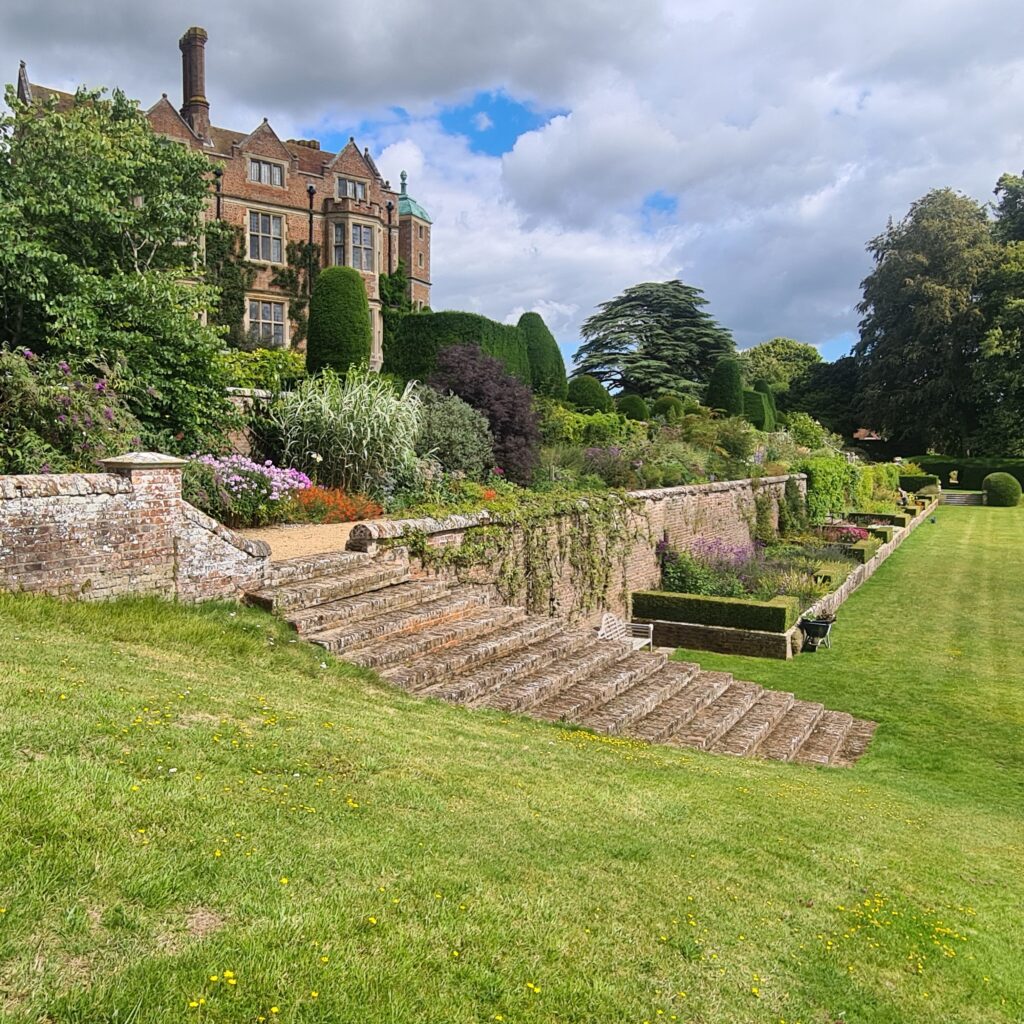


This was a point-to-point walk from Golders Green, N to Hampstead Garden Suburb, S to Hampstead, NE looping around the village, then SW back to Hampstead.
This walk being in London, the whole route was packed with history, some of which Khris had kindly distilled to present on the day. An awful lot of stuff happens in London.
The usual stats:
- Event led by Khris R.
- Attendance: 16 men.
- Distance: 5.69 miles (9.2 km).
- Altitude per GPS: low 328ft (100m), high 574ft (175m), climb 1289ft (392.9m), descent 1213ft (369.7m).
- Time: start 11:05, end 15:26 (sunset 15:51), lunch 36 minutes, other breaks 24 minutes.
- Speed: moving arithmetic average 1.7mph (2.7kph).
- Terrain: pavement and forest (off-road) track.
- Weather: ideal for walking, clear skies, temperature range between 6°C and 8°C, westerly wind 10mph (16.1kph).
- Number of sewage works: 0.
- Number of churches: 4.
- Number of golf courses: 0.
- Number of Waitroses: 0.
Churches:
- Hampstead Garden Suburb Free Church, Hampstead. Founded in 1910, the Free Church aspired to be open to all denominations of Christianity, in parallel with the ambitions of Ebenezer Howard in his Garden Cities. The Free Church is a grade I listed building.
- St Jude-on-the-Hill, Hampstead (history). Edward Lutyens influenced the design of this somewhat over-sized parish church. The church was consecrated in 1911. St Jude’s is a grade I listed building.
- St Mary’s RC Church, Holly Walk, Hampstead (wiki). St Mary’s was the first Roman Catholic church built in Hampstead after the English Reformation, 16th century.
- St John’s Church, Church Row, Hampstead (wiki). St John’s is the parish church of Hampstead. Its history goes back to 986, when the land of Hampstead was granted to Benedictine monks of Westminster Abbey. This immediately tells us that all subsequent history is going to be complicated, and this event report is already too long.
Points of interest:
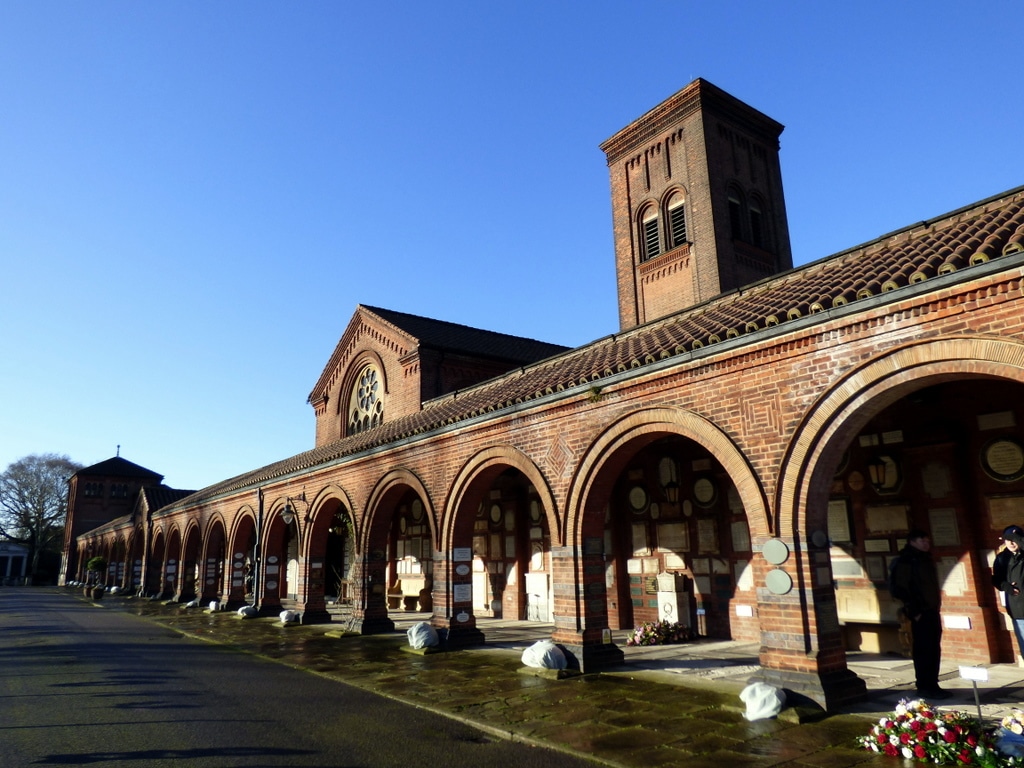
- Golders Green crematorium (company) was the first crematorium in Britain, opening in 1902, following the legalisation of cremations in Britain in 1885. A remarkable place, a palace to remembrance, with enough plaques and urns to read for an entire lifetime. The company lists a few famous names on its website (Huggins, Bolan, Amis, Moon and Freud), Wikipedia names as many as it has found, including Barbara “Babs” Windsor, Sid James (these two were a right Carry On…), Bernie Winters, Amy Winehouse, Dale Winton, Peter Sellers (and his wife), Ivor Novello, David Gest, Enid Blyton, Eric Coates, Mollie Sugden (Mrs Slocombe), John Inman (Mr Humphreys), Wendy Richard (Miss Brahms) (these three acted in Are You Being Served?, a British sitcom about a department store ), Peter O'Toole, T S Elliot, Charles Gray (aka Ernst Stavro Blofeld), Anna Pavola, Bram Stoker (writer of Dracula), Victoria Wood, Peggy Ashcroft, Ernest Bevin, Neville Chamberlain, Ian Dury (“Hit Me With Your Rhythm Stick”), Rudyard Kipling, Edwin Lutyens, Matt Monro and many, many more. The building contains two mini-towers, one of five storeys and the other of three storeys, stacked with urns. In the arches of the cloisters facing the memorial grounds are thousands of plaques, with space for thousands more. The building itself is a grade II listed building. It was designed by Ernest George and Alfred B Yeates between 1901 and 1939, the latter continuing to design minor features beyond 1920. The grounds of the crematorium is a grade I listed park & garden, designed by William Robinson. Inside the grounds are other grade II listed mausolea.
- To the north of Hoop Lane, and not part of this walk, is Hoop Lane Jewish cemetery (wiki), itself a grade II listed park & garden. Notable burials include Nathan Saatchi (yes, that Saatchi family), Jacqueline du Pre, Marjorie Proops and Jack Rosenthal.
- Central Square of Hampstead Garden Suburb (wiki). The central square of Hampstead Garden Suburb conforms to the expectation of a central square in Ebenzerr Howard’s vision of a Garden City. This was, in part, because the designers whose master plan made Letchworth Garden City – Barry Parker and Raymond Unwin – also designed the master plan for Hampstead Garden Suburb. The central square was intended to be the community’s focal point, so here we find two churches (the Free Church and St Jude’s on the Hill). Henrietta Barnett founded the Hampstead Garden Suburb Trust Ltd, which purchased the land in 1906. Today, the look and feel of the suburb is much like Welwyn Garden City, more so than the prototype garden city of Letchworth. Note also that Hampstead Garden Suburb is in the London Borough of Barnet, whereas Hampstead proper is in the London Borough of Camden.
- The Great Wall of Hampstead Garden Suburb. Yes, there is one. It’s not quite an impressive as its Chinese namesake, and had no particular military purpose (other than perhaps to keep the hoardes of Camden out?), but it is a grade II listed building.
- Mega-posh houses alongside Hampstead Heath Extension, one house having mounted Marvel Comic superheroes on its roof.
- The woodlands of West Heath.
- Hampstead Pergola, now owned by City of London Corporation, overlooks West Heath. It was the dream of two men. The first was William H Lever, later Lord Leverhulme, the businessman behind the Lever Bros (subsequently Unilever), a wealthy idealist, patron of the arts, architecture and landscape gardening. Lever likely funded it. The second was Thomas Mawson, the celebrated landscape architect, who design the pergola and its gardens. The pergola was built between 1905 to 1906, expanded twice in 1911 and 1925. Lever’s objectives for the pergola were essentially vanity; he wanted a setting for his garden parties. Short history.The pergola is a grade II* listed building.
- Whitestone Pond, also known as Hampstead-on-Sea, is 135 meters above the London Basin.
- Admiral’s House, Hampstead, properly known as The Grove, is nicknamed for its appearance as some sort of boat. But no boatsmen have ever lived here, let alone admirals. But an actual admiral, Admiral Scott did live elsewhere in Hampstead, where he indulged his habit of firing cannon from the roof of his house. The confusion arose when gossip-mongers mixed up Admiral Scott’s cannon fire with the “quarterdeck” of The Grove. The Grove was built in 1700, has been used as a masonic lodge, housed George Gilbert Scott (who extended it) and is now a grade II listed building (with exceptions).
- Fenton House & Garden is a National Trust property, originally a merchant’s house. Lady Binning bought the house in 1936 and filled it with her highly decorative collections of porcelain, Georgian furniture and 17th-century needlework. The house also contains a collection of early keyboard instruments from Benton Fletcher. Fenton House is a grade I listed building.
- The Wells & Campden baths and wash houses, built in 1888, reminded us that Hampstead was not always filled by rich merchants (17th century) and media luvvies (21st century). The workers cottages had no running water, so they used communal water facilities. The building was converted to housing in 1985 and it is a grade II listed building. Carved into the building is the spelling “Campden”, not “Camden”.
- Gerald du Maurier’s house, Cannon Hall, was originally built in 1720s, extended over the years and is now a grade II* listed building. Cannon Hall benefits from the old parish lock-up installed into its garden wall (!). Unsurprisingly, the lock-up is a grade II listed building.
- The Logs, Wells Road, is a grade II listed building, of which number 1 was the former home of Boy George. George assaulted model and male escort Audun Carlsen in April 2007, presumably in this property.
- St John’s Church has a glorious interior – clearly funded by wealthy merchants in prior centuries – which was today being set up for a concert. The graveyards next to the church feature more historic names, including John Constable and Hugh Gaitskell.
Five members joined the optional pub stop at the King William IV pub, Hampstead.
For more pictures, see https://bit.ly/gocgoldersgreendec24.
Epilogue: “Raise a glass for everyone – Underneath that burning sun in Africa”, being lyrics from the song Do They Know It’s Christmas?, written by Bob Geldof and Midge Ure in 1984 for the supergroup Band Aid.


Words by Martin Thornhill. Pictures by Peter O’Connor.