
This walk was a pilot for an indoor, art-related social event, with some ambulatory exploration of a small town.
The usual stats:
- Event led by Martin T.
- Attendance 3 people.
- Distance: not measured.
- Altitude per GPS: not measured..
- Time: start 11:00, end 13:30.
- Speed: not measured.
- Terrain: indoors, pavement.
- Weather: perfect for walking, mainly sunny, excellent visibility at ground level, temperate range between 19°C and 21°C, easterly wind 10-16mph (16-25 kph) with no wind-chill.
- Number of sewage works: 0.
- Number of churches: 2.
- Number of golf courses: 0.
The event was divided into three parts:
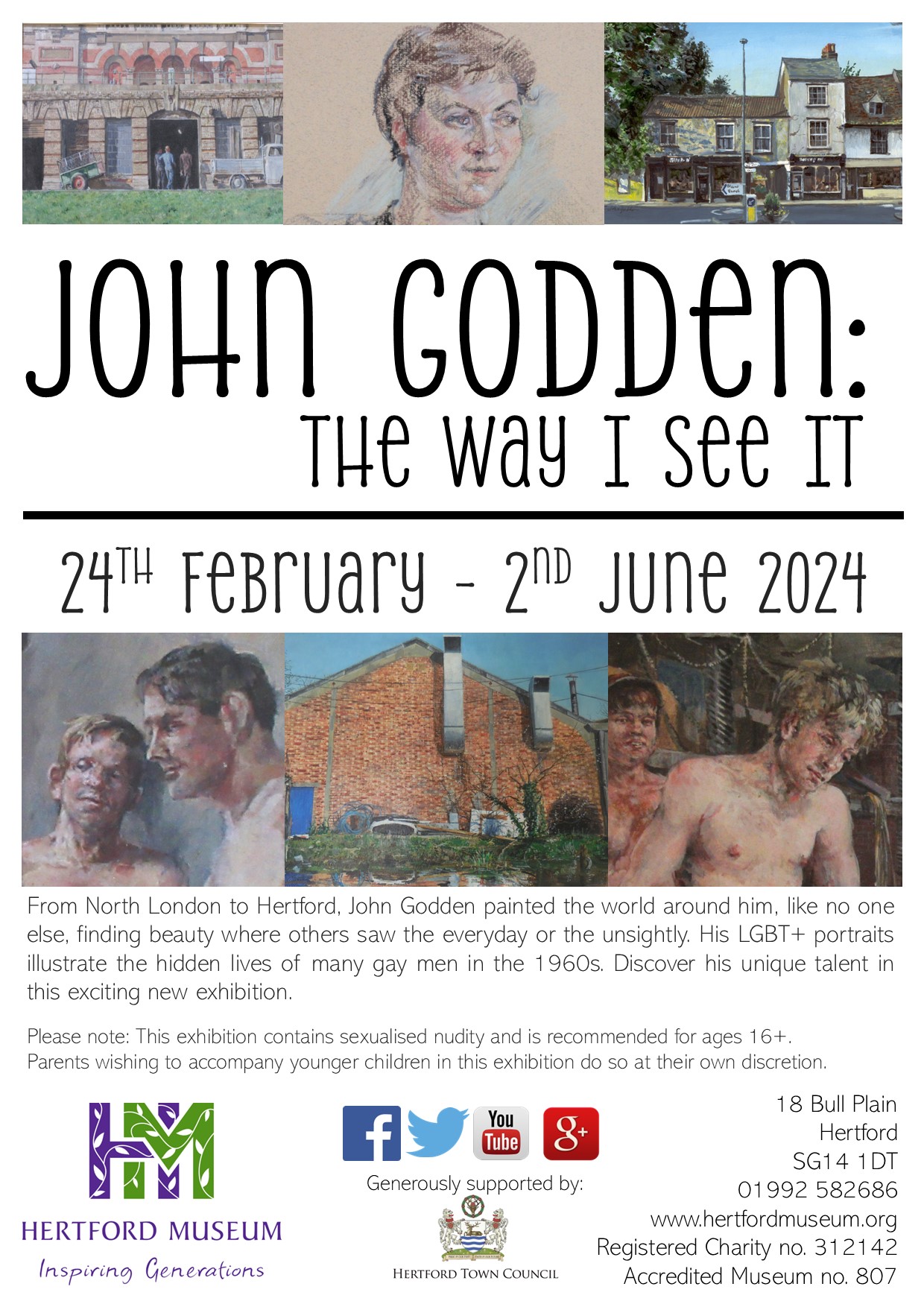
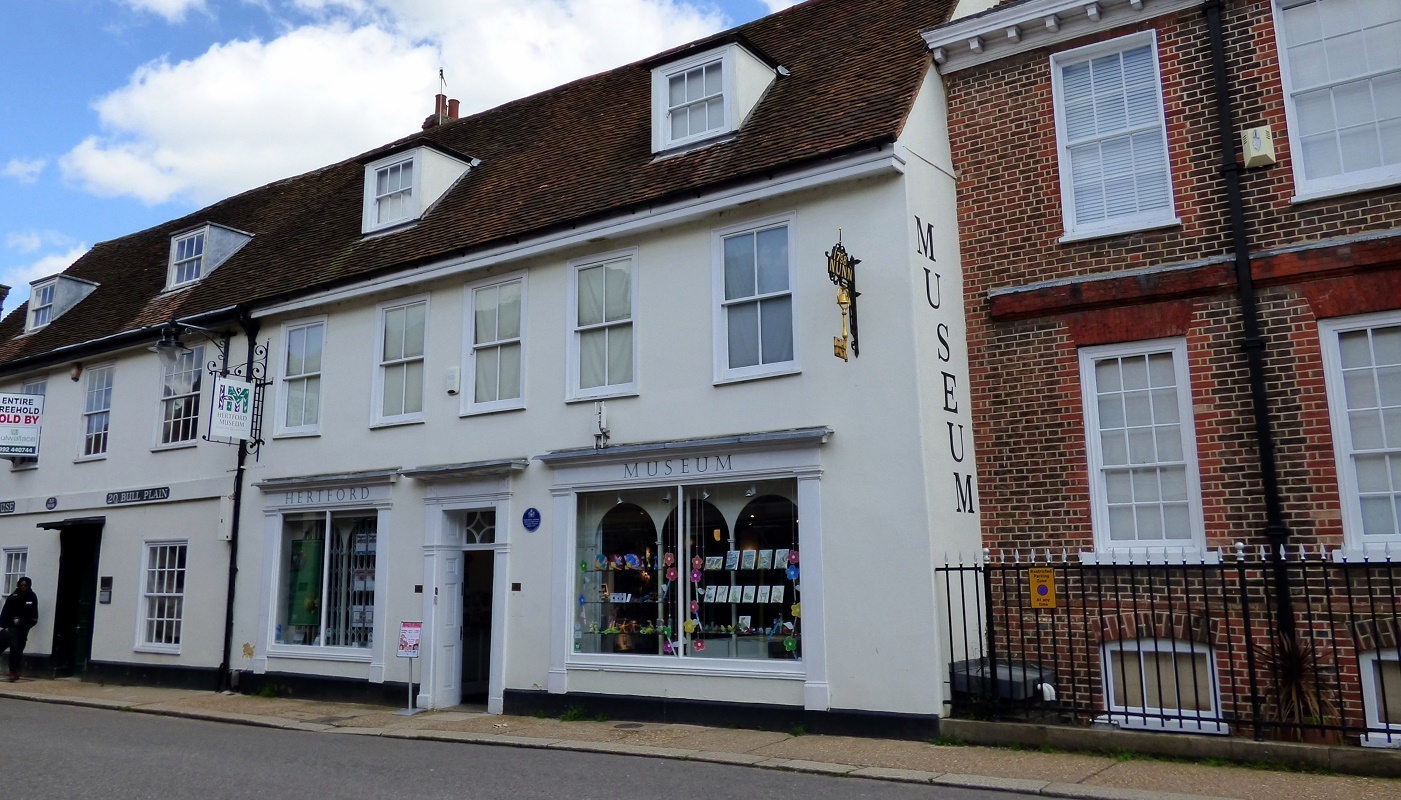
- a visit to the Hertford Museum, the main objective being an art exhibition of the works of John Godden;
- a coffee break;
- an amble around Hertford, using some of its Heritage Trail.
The artist John Seymour Godden was born in 1930 and was raised in Worthing, West Sussex, from which he moved to Islington, Tottenham and, finally, Hertford. He taught himself to paint, studying the most mundane of environments – a wall, a coal yard, the side of a small industrial unit – in which to refine his ability to capture details with exacting precision. One of his methods was to take photographs as he cycled through his home environment, then convert the developed photograph into paintwork in his studio. This gave him an unlimited amount of time to perfect his ability to replicate the aspect on canvas. Godden painted throughout his life, from 1963 to 1992.
The results are quite astonishing. For example, his study of brickwork captured the mortar between the bricks and the variation of colours and visual textures of each brick. Where there were lichens on eaves, each nuance of shape and hue were recorded. His study of metallic exhaust flues aside small factory units captured the variation in the reflection of sunlight. He achieved similarly for the side of a slightly rusty railway bridge in North London. His study of water reflected light and images of objects above the waterline. These appeared to be Godden testing his own accuracy of observation and replication.
One particular view was immediately recognisable: it was a view from Archers Green Lane, nr Tewin, looking westbound up the Mimram Valley, with the (now) cottage resorts of Tewinbury Farm nestled in the valley floor. We walked that point on our walk last month, Bramfield.
Other aspects of Hertfordshire life included one particularly well known spot, Hertford Lock, taken at this point. In the 1960s, it was quite an open picture of a lock with the lockdown. By In Oct2018, Uy Hoang took this 360° shot by the lock, showing that trees had hidden the lockhouse).
Godden experimented with some abstract images, apparently drawing inspiration from Picasso’s paintings and perhaps Gaudi’s sculptures.
Of GB interest – of lesser interest to LTQI+ – was Godden’s sketches of men, reportedly dated to the 1960s. Some of these could have been studies of models. Other sketches might have been fantasy, including one scene of a flogging and another scene depicted in a dungeon. The dungeon scene also featured flogging, men manacled high up a wall, blood spatter and a roaring fire: was this Godden telling us what Hell looked like? Godden, it seems, might have been into hardcore BDSM.
In other exhibitions, Hertford Museum briefly mentioned its town twinnings and hosted a broad collection of chattels donated over the years by locals, including a taxidermist collection (reminiscent of the Rothschild collection at Tring Natural History Museum), local celebrities, household objects (1850s to 1970s), a section about the Addis toothbrush factory, the Hertfordshire Regiment (Territorial Army), breweries (Hertford is the base of brewery McMullens) and, outdoors, a Jacobean garden.
There were no sewage works on the event, but there was a souvenir (!) pamphlet for the opening of sewage works in 1926.
Coffee was at El Vino Restaurant, set up in the day as a fast cafe. The place was packed; we were lucky to find seating outside.
The ad lib tour of Hertford started with All Saints Church. This was our first time inside the church. The interior is grand, but modest, with beautiful red/pink brick used throughout. Aside from some explanations about regimental colours (flags) mounted above the altar, remarkably, there were no memorials stuck to the walls. In most churches, those who donated much to the church ended up with some ostentatious memorial plaque occupying vast spaces of walls. But not in this church.
We moved to St Andrews Church. This is even more modest than All Saints, and a lot smaller. However, here there is a large memorial plaque. The plaque covers the Dimsdale family, starting with Nathaniel Dimsdale, a medic, a vaccinator, a banker and a Baron of All The Empires of the Russias Etc Etc, who died in 1811 aged 64 as a bachelor. He was well-connected in Hertford, being an alderman, was twice a parliamentary representative and a member of the Royal Society. He was the second son of a Quaker, Thomas Dimsdale, who died in 1800 aged 89.
The name Dimsdale also relates back to Godden. Godden lived at 21 Dimsdale, Hertford. Small world.
The tour continued to the Hertford Castle gatehouse, the park and ended just outside The Blue Oyster Bar, a fishmonger and fish restaurant.
Churches:
- All Saints Church, Hertford
- Hertford St Andrew, St Andrew Street, Hertford.
For pictures, see https://www.flickr.com/gp/anemoneprojectors/8rBck9DBT4.
Words by Martin Thornhill. Pictures by Peter O’Connor.